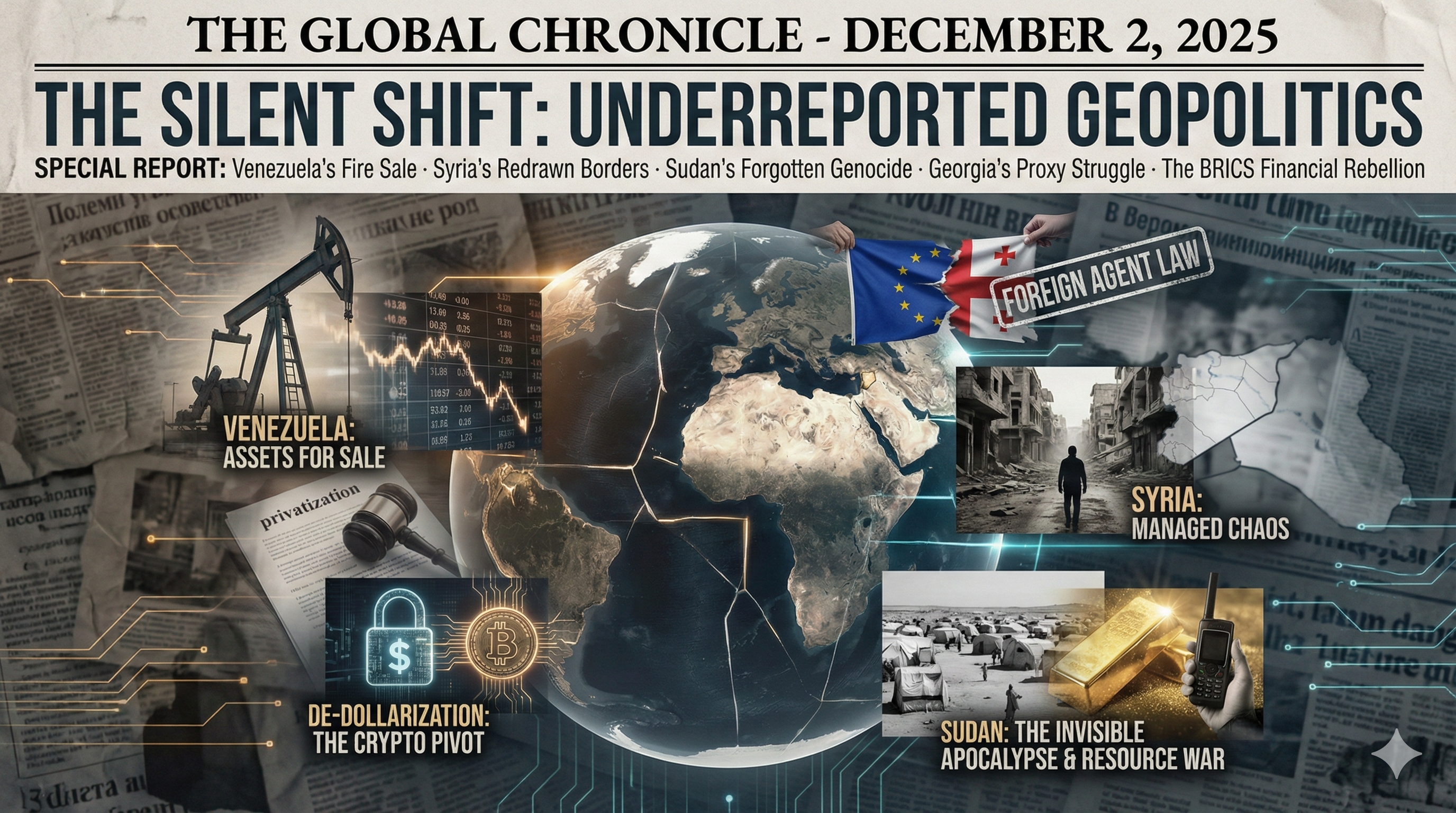
I spend a lot of time digging through independent media and alternative sources, and every so often I come across stories that make me wonder why nobody is talking about them. These are geopolitical shifts with real consequences — the kind of things that shape the world years before they show up in history books. Here are five that caught my attention this week.
1. The “Privatization” of Venezuela: A New US Strategy?
While most mainstream outlets are busy covering election disputes in Venezuela, I stumbled on something far more interesting — and frankly more worrying. Ben Norton at the Geopolitical Economy Report has been tracking a quiet but aggressive economic strategy playing out in Latin America.
What struck me is this: opposition figures, apparently emboldened by renewed US backing, are floating proposals to privatize Venezuela’s state assets — and we’re talking about the largest oil reserves on the planet. Norton describes a “fire sale” mentality where assets worth trillions could be handed over to Western corporations for pennies on the dollar, all in exchange for political support.
This is where it gets really important, in my view. The whole narrative shifts from “promoting democracy” to straight-up resource acquisition. Norton makes a compelling case that this is essentially a return to early 20th-century “Gunboat Diplomacy” — except now it’s being waged through economic warfare and lawfare instead of marines. And it’s not just Venezuela. Over in Ecuador, there’s been significant backlash against proposals to host new foreign military bases. Independent observers are framing this as local elites desperately trying to secure US protection — against their own populations.
This is exactly the kind of financial incentive behind regime-change narratives that outlets like the BBC or CNN never seem to get into. They stick to the human rights framing and skip the economic context entirely. Check out Ben Norton’s Geopolitical Economy Report if you want to dig deeper.
2. Post-Assad Syria: The “Managed Chaos” & Israeli Expansion
It’s been a year since the seismic shifts in Damascus — the “Ouster of Dec 2024” as some reports call it — and Syria is still in a state of dangerous, managed chaos. The thing is, most Western audiences have simply moved on. I was reading The Cradle and other regional independent analysts, and two trends jumped out at me that are barely getting any coverage:
First, there’s emerging evidence of targeted sectarian violence in Homs and the coastal regions, particularly against Alawites and Christians. During the initial rebellion, the dominant narrative was all about “freedom fighters.” Now we’re seeing a grim settling of scores, and Western capitals seem uninterested in asking uncomfortable questions about who they supported.
Second — and this one really concerns me — Israeli military movements in southern Syria, near the Golan and beyond, appear to be solidifying into a permanent buffer zone. This is essentially a silent annexation happening under the guise of “security.” And there’s been almost no pushback from the international community.
What this tells me is that the major powers have a tacit agreement to let Syria fracture into spheres of influence: Turkish control in the north, Israeli in the south, and a weak, aid-dependent rump state in the middle. The map of the Levant is being quietly redrawn. Follow The Cradle for ongoing coverage.
3. Sudan’s “Invisible” Apocalypse: The Fall of El Fasher
This is the one that keeps me up at night. Independent observers are calling Sudan’s civil war the most ignored genocide of the 21st century, and I think they’re right. As of December 2025, El Fasher in North Darfur has fallen to the Rapid Support Forces (RSF), triggering a humanitarian catastrophe that is almost entirely absent from Western front pages.
Mainstream media occasionally drops the word “famine” and moves on. But what independent bloggers and diaspora journalists are documenting is far more systematic — ethnic cleansing on a horrifying scale. What really gets me is the money trail: the UAE and other regional actors are funding the RSF specifically to secure gold and agricultural resources. Meanwhile, the West looks the other way to preserve its Gulf alliances.
And here’s something I didn’t expect: the UN’s ability to intervene or even report accurately has completely collapsed. The documentation of atrocities is now left to decentralized networks of Sudanese activists who are literally using Starlink terminals to bypass internet blackouts. It’s both inspiring and devastating.
This is a complete failure of the so-called “Rules-Based International Order” in Africa. The silence isn’t an accident — it’s a political choice, driven by the desire to stay cozy with the Gulf sponsors of these warring factions. If you want raw, unfiltered updates, search for “Sudan War Monitor” or follow hashtags like #KeepEyesOnSudan.
4. Georgia’s “Foreign Agent” Crisis: The Color Revolution That Wasn’t?
Georgia has been a powder keg ever since those controversial “Foreign Agent” laws were introduced a year ago. The mainstream framing is simple: “Pro-Russia vs. Pro-Europe.” But when I started reading independent analysts and local Tbilisi bloggers, a much more nuanced picture emerged — something more like “sovereignty vs. NGO-cracy.”
From what I can gather, the government in Tbilisi has actually weathered the initial storm of protests. But now the country is facing what looks like a silent economic strangulation from the EU. The most eye-opening finding from alternative media is that those “pro-democracy” NGOs are being funded almost entirely by external actors and essentially functioning as a parallel government — a state within a state.
The angle that almost never makes it onto Western TV is how rural Georgians are growing increasingly resentful of the EU integration process. They see it as a threat to their traditional values and economic stability. Whether you agree with them or not, it’s a perspective that deserves to be heard. The binary “West is Good / East is Bad” narrative just doesn’t hold up here. The “EU Dream” is losing its shine in non-member states, especially when it comes bundled with heavy political conditionalities.
For a deeper take, check out The Duran — Alexander Mercouris and Alex Christoforou have been all over this story.
5. The “BRICS Unit” Reality Check: Crypto Over Gold?
I’ve been following the “imminent dollar collapse” narrative for a while now, and here’s the reality check: the formal BRICS currency project, nicknamed “The Unit,” has essentially stalled. India’s resistance to a China-dominated basket has frozen the whole thing for 2025. So much for a grand unified challenge to the dollar.
But here’s what I find genuinely fascinating and what the mainstream media is largely ignoring. While the unified currency project flounders, Iran and Russia are moving ahead with state-backed crypto-settlements — bilateral blockchain settlement systems that completely bypass SWIFT. They’re not waiting for the rest of BRICS to get on board. This “fragmented de-dollarization” is messier, less glamorous, and probably more unstoppable than a single unified currency ever would be.
What this tells me is that the future isn’t some shiny new “Euro-style” currency for the Global South. It’s a decentralized mesh of digital payment systems that, bit by bit, makes sanctions impossible to enforce. That’s the real story.
Pepe Escobar over at Asia Times has been tracking this closely, along with several financial Substackers worth following.